Takeoff and landing performance for your simulator flight
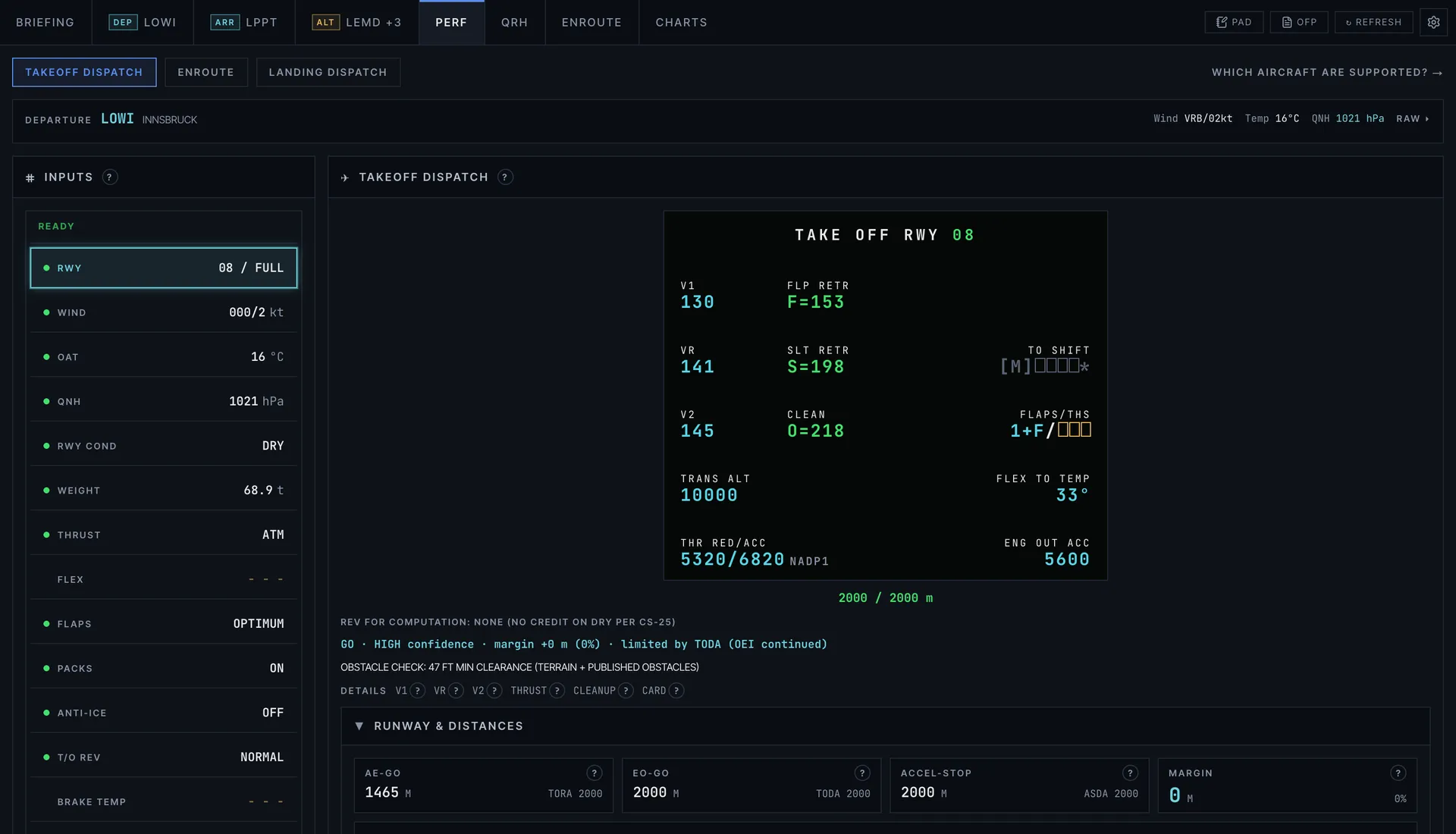
SkyNexus reads your SimBrief flight plan and the latest METAR and works out the takeoff and landing numbers for the aircraft you filed: V-speeds, the reduced thrust temperature, the flap setting and the margin on every runway distance. Each type has its own model, from the A320 to the A380-800. It is free and runs in your browser next to MSFS 2024, MSFS 2020, X-Plane or P3D.
What you get for every type
- V1, VR and V2, with the minimum control speeds as a floor.
- FLEX or assumed temperature, or full thrust when the runway or the climb needs it.
- OPTIMUM flap: every takeoff flap is checked and the one with the most runway margin wins.
- All three distances checked against the runway: all engines, engine failure and continue, and accelerate-stop, against TORA, TODA and ASDA, with the regulated takeoff weight for the day.
- An obstacle check against terrain and published obstacles on the departure path.
- Landing distance factored for dispatch and unfactored for the day, with autobrake and reverse thrust, and a prediction of the runway exit you will make.
Supported aircraft
SkyNexus picks the model from the aircraft type in your SimBrief flight plan. The A320 family and the 737-800 are checked against published tables (on the A321neo only the landing side; its takeoff is approximate) and have the most depth, such as MEL items, landings with a failure and a handbook in the QRH tab, depending on the type. The 777-300ER and A380-800 are newer and indicative, built from public planning data, and every result for them says so.
- A320 and A320neo (CFM56-5B4 and LEAP-1A26): FLEX, OPTIMUM flap and the engine-out procedure, with MEL items on the A320ceo.
- A321 and A321neo (V2533-A5 and LEAP-1A32): QRH landing distances and 13 failure cases for both.
- 737-800 (CFM56-7B26): derates, QRH VREF and landing distances, non-normal landings and brake cooling.
- 777-300ER (GE90-115B): assumed temperature and OPTIMUM flap, indicative numbers.
- A380-800 (GP7270): FLEX and four-engine climb rules, indicative numbers.
Inputs come from your flight
Weight, runway, wind, temperature and QNH are read from the OFP and the latest METAR, so the first answer is on screen before you have finished the cockpit setup. Change any input, such as an intersection, a wet runway or a different flap, and the numbers update as you type. The result is laid out like the takeoff page in the aircraft, an MCDU for the Airbus types and an FMC for the Boeing types, so you can copy it straight across.
- How the SimBrief import works and what else the briefing builds from your OFP.
Where the numbers come from
Each model is built from public Airbus and Boeing material, the EASA type certificates and the open-source OpenAP performance library. Every number has a help button that explains how it was worked out, and a confidence tag says how sure the model is. This is a tool for flight simulation and learning. Never use it for a real aircraft.
Landing distance
The landing side has its own page, with the difference between the required and the actual landing distance and how the runway condition changes it.
Notes for popular add-ons
Takeoff performance calculator FAQ
- Is the takeoff performance calculator free?
- Yes. Create an account, enter your SimBrief Pilot ID and the performance tab is there for every supported flight plan, takeoff and landing.
- Which aircraft are supported?
- The A320ceo, the A320neo, the A321, the A321neo and the Boeing 737-800, for takeoff and landing. The Boeing 777-300ER and the Airbus A380-800 have indicative takeoff and landing numbers. Other types show a message that they are not supported yet.
- Does it work with MSFS 2024 and X-Plane?
- Yes. The inputs come from SimBrief and the weather, not from the simulator, so it works next to MSFS 2024, MSFS 2020, X-Plane and P3D, with any add-on of a supported type.
- Does it do landing performance as well?
- Yes. For every supported type you get the landing distance factored for dispatch and unfactored for the day, with autobrake and reverse thrust, and the predicted runway exit. Each type page lists what that type adds, such as QRH landing distances or landings with a failure.
- How accurate is it?
- The A320 family and the 737-800 are checked against published tables and are accurate enough to fly a realistic departure in the sim. The A321neo takeoff numbers are approximate, and the 777-300ER and A380-800 numbers are indicative. None of it is certified, and it must never be used for real flights.
Get your numbers for the next departure
Free, in the browser, filled in from your SimBrief flight plan.
Open SkyNexus