Why V1 exists: the stop or go decision before takeoff
Fail an engine at any speed on a short runway and see what V1, VR and V2 are for, with interactive demos.
By Joeri Smits, founder of SkyNexus
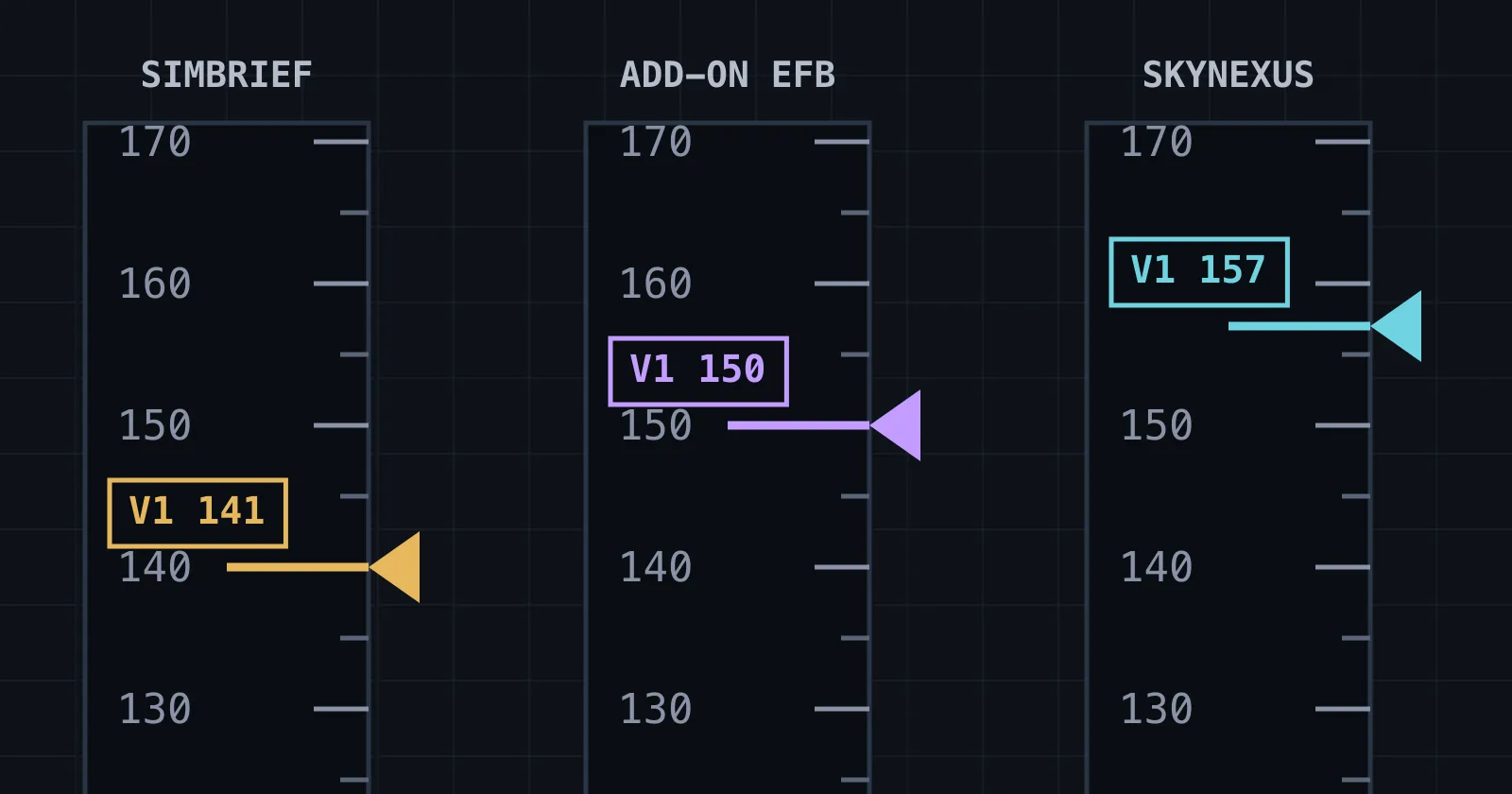
You type three numbers into the FMC before every takeoff: V1, VR and V2. SimBrief or a calculator gave them to you, so you never really had to ask where they come from. Then on the runway the callout comes, “V1”, and the aircraft carries on rolling exactly as it was.
So what is that speed for? The quickest way to find out is to break something. Here you will fail an engine at any speed you like and watch what happens on the runway, one idea at a time.
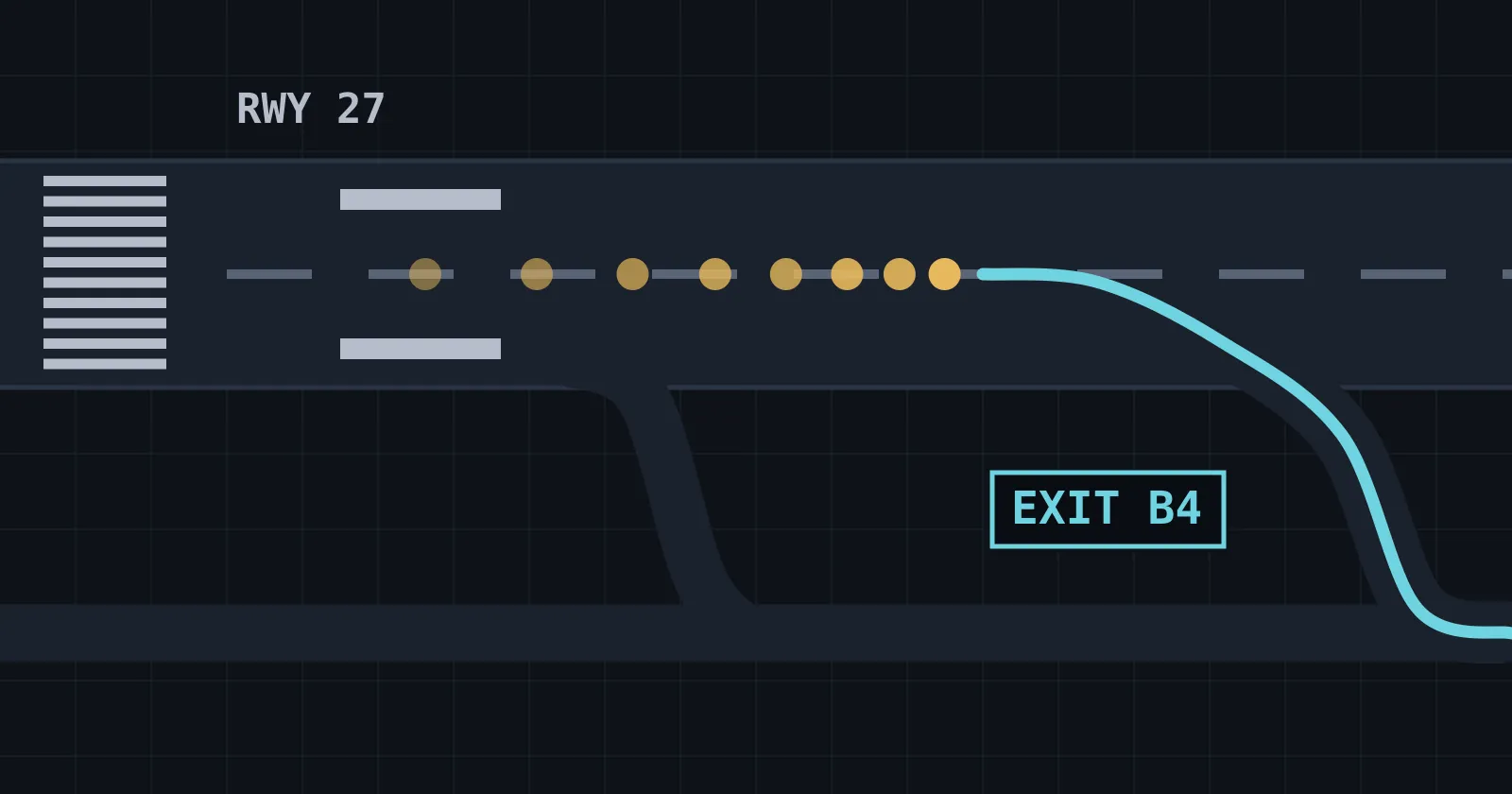
Every picture uses the same twin-engine jet, about the size of an A320, flying light on a 1,500 m runway. A short runway makes the effects easy to see. The numbers come from a simple model built for this post, so they are illustrative, not real data.
A normal takeoff
Press the button and watch the three speeds go by. What happens at V1?
Illustrative
Nothing happens at V1. The wheels are still firmly on the runway. VR is where the pilot starts to raise the nose, and the aircraft leaves the ground after that.
So V1 cannot be about flying. The aircraft does nothing special at that speed. To find out what it is for, something has to go wrong.
An engine fails early
What happens if an engine fails while you are still going slowly?
Illustrative
Nobody would argue about this one. Look closely, though: the brakes do not come on at the moment the engine fails, because the demo allows about two seconds for the pilots to react.
The later it fails, the harder it is to stop
Now you pick the speed. Slide it right and watch what the brakes have left to work with.
How fast can you be when the engine fails, and still stop on the runway?
Illustrative
Stops with 640 m to spare
In this picture the last speed is just past 139 knots, and the strip under the runway keeps a record of it. The later the failure, the more runway is already behind you. On top of that, braking gets expensive fast. Go twice as fast and the brakes have four times as much to deal with. Even those two seconds cost more: about 80 metres at 80 knots, and more than 130 metres at 130 knots.
So keep going instead?
If you cannot stop, the other choice is to carry on. One engine can still get the aircraft into the air, but it takes much longer, because half the thrust is gone and the drag is not.
Only just getting the wheels off before the end is not good enough, because whatever is past the fence is still in the way. The rules ask for 35 ft over the end, so the picture now has a gate there marked “high enough”.
How slow can you be when the engine fails, and still clear the gate on one engine?
Illustrative
Clears the gate at the runway end
This one runs the other way round. A late failure is the good case, because you already have most of the speed you need. Fail at 90 knots and the aircraft is still on the ground when the runway ends. Fail at 105 and it gets airborne, but passes far too low. From about 115 knots it clears the gate.
Put them together
You now know two things about this runway. Below about 115 knots you cannot go, and above about 139 knots you cannot stop.
Here is the same slider with both outcomes on the runway. Which one works at each speed?
Illustrative
Both work. Below V1, so you stop
Look at the strip. The two zones overlap, and anywhere in there the aircraft can either stop on the runway or clear the gate.
That sounds like good news until you picture it happening. An engine has gone, the aircraft is pulling to one side, a warning is sounding, and there are only seconds to choose. That is a bad moment to start working it out.
So the speed is worked out before the flight. One speed inside the overlap is picked and given a name, and that speed is V1. In these pictures it is 125 knots. Nobody has to calculate anything at speed, although the call itself still has to be made by V1. For an engine failure, or anything else that serious, the rule is short: below V1 you stop, above V1 you go. It holds whatever you feel at the time. Just past V1 your instinct may be shouting at you to brake, and the numbers only promise you the go. V1 has nothing to do with lift.
That is why one pilot keeps a hand on the thrust levers until V1: the Captain on an Airbus, the pilot flying at some Boeing operators. Below V1, that hand may have to pull them back. Once V1 goes by, the answer is go, so the hand comes off.
Why not lift off earlier?
The other two speeds really are about flying. Leaving the ground sooner would make the whole problem smaller, so what stops it?
Slide the speed up. When does lift catch up with weight?
Illustrative
Nose level: lift is far below weight, so the wheels stay down
With the nose level the wing does not lift much. At a given wing angle, lift goes with the square of speed, so at half the lift-off speed it carries about a tenth of the weight here, and even at VR only about a third.
VR is where the pilot starts to raise the nose. That tips the wing up, so the air pushes it harder, and lift catches up with weight. Pulling the nose up much earlier does not help: the wing is not moving fast enough yet, and on most airliners the tail reaches the runway first.
V2 belongs to the bad day. It is the minimum speed to hold on one engine after takeoff, the speed at which the aircraft can still climb safely, and it has to be reached by the time you pass the gate.
That leaves one loose end from the strip: the stop zone runs on past VR, yet V1 is never above VR. By then the nose is already up and the aircraft is on its way into the air.
A heavier aircraft
So far the aircraft has been light. Add weight and every part of this gets harder. It takes longer to speed up, the brakes have more to stop, and one engine has more to lift.
What happens to the two limits when the aircraft gets heavier?
Illustrative
Both limits overlap, so V1 has room
At first the overlap only gets smaller, and the V1 mark gets pushed along to stay inside it. At about 60 tonnes the zones just touch, and exactly one speed is left where both stopping and going fit. That has a name you have probably seen: a balanced field. The stop and the go need the same distance, and that distance is the balanced field length. In this picture it equals the runway, so the weight is at its limit.
Add one more tonne and the zones move apart. Now there is a gap, a stretch of speeds where an engine failure leaves you unable to stop and unable to go. On this runway that takeoff is not allowed. The aircraft has to carry less weight or use a longer runway.
The chart pilots know
If you have read about V1 before, you may have seen a chart with two lines on it. You already know what it says. Along the bottom is the speed at which the engine fails, and up the side is the distance needed. The stop line rises, because a later failure takes more runway to stop from. A later failure also leaves less to do on one engine, so the go line falls until VR, then stays about flat. The straight line across is the runway.
Where does each line meet the runway, and what does that tell you?
Illustrative
Stop needs 1,110 m, go needs 1,410 m: both fit
The stretch between those two points is the overlap from the strip. V1 can be anywhere in it up to VR, here 125 knots, so it does not have to sit where the lines cross.
The day moves it too
Weight is only one of the things that move these limits. The weather and the airport do it as well.
What does each of these do to the two limits?
Illustrative
A normal day: the two limits from before
A hot day, 40 degrees here, and a high airport, 2,000 ft here, do much the same thing. Engines hold full thrust only up to a certain temperature, and 40 degrees is past it. High up, the thinner air takes thrust away. Either way the engines push less, the aircraft has to run faster over the ground, and both limits move towards each other.
A headwind goes the other way. The wing only cares about the air moving over it, so with 15 knots on the nose the aircraft is slower over the ground, and the brakes have less to get rid of. The demo counts all of that wind, where real data counts only half of a headwind. A tailwind does the opposite.
A wet runway is the odd one out. Tyres grip less on a wet surface, so the stop limit drops, and V1 has to drop with it to stay in the overlap. Only the stop limit moves here, but that is the demo, not the rule.
Spending the spare runway
On most days the runway is longer than the takeoff needs, and the overlap is wide. That spare runway can be used for something.
How much thrust can you take away before the limits meet?
Illustrative
Full thrust leaves the most spare runway
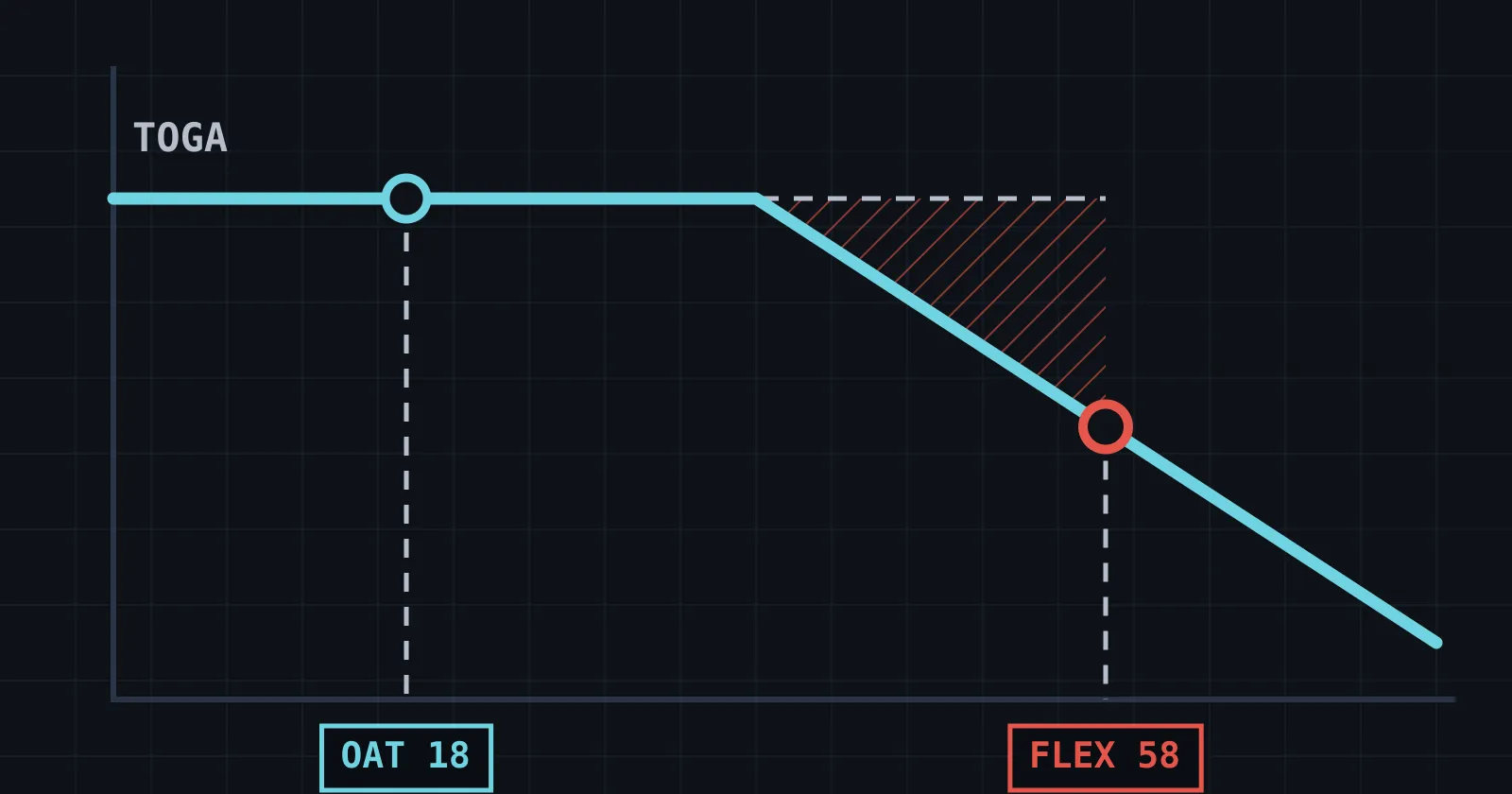
Less thrust means less wear on the engines and lower maintenance cost, so airlines use it whenever the runway allows. Airbus calls it FLEX, and Boeing uses an assumed temperature. The spare runway shrinks, but every required margin is still met, and real reductions are capped at 25 percent. In this demo the limits touch at 20 percent.
How the number is found is in FLEX and assumed temperature, explained.
Why a real calculator gives a different number
Everything above is a simple model of one takeoff, built to show the idea. A real calculator starts from data for your exact aircraft, engines and flap setting, on the runway as it really is, with its slope and the distance you lose lining up. It also checks an all-engines takeoff, climb, obstacles and brake energy, which the demo leaves out.
The demo simplifies the timing too. On a real takeoff, noticing and reacting happen before V1, so the first stopping action comes by V1. Separately, the rules add a distance equal to two seconds at V1 as margin. The demo’s two seconds stand in for both. So the real rule is sharper than the short one above: if the stop has started by V1 you stop, and if not, you go. A failure just below V1 can be noticed after V1.
A few more things differ. Below a speed called VMCG the go is not available at all, because the aircraft cannot be held straight on one engine, so V1 cannot go lower. The demo draws a straight line from low speed, and a real aircraft could not hold that. Real wet data lets the one-engine case cross the gate at 15 ft, although the takeoff can never be shorter than the dry distance, and that lower gate is part of why V1 can drop. The runway here also has no stopway or clearway.
Even real calculators do not always agree with each other, partly because the place to put V1 inside the overlap is a choice. Why takeoff calculators disagree goes through the reasons one by one. For your own flight, the SkyNexus takeoff calculator reads your SimBrief plan and the latest METAR and works out V1, VR and V2 for the aircraft you filed.
Next time you hear V1 called, nothing has changed in the aircraft. Only the answer to an engine failure has changed, from stop to go.
Questions pilots ask
- What is V1 in simple terms?
- V1 is the speed by which the stop or go decision is made and the first stopping action taken, and it is worked out before the flight. If the stop has started by V1, you stop. If not, you go, even if stopping feels like the safer choice. A failure just below V1 can be noticed after V1, and then you go. The aircraft does not lift off or do anything else at V1.
- What is the difference between V1, VR and V2?
- V1 is the speed by which the decision is made and the first stopping action taken. VR is the speed at which the pilot starts to raise the nose. V2 is the minimum speed to hold on one engine after takeoff, so the aircraft can still climb safely. They always come in that order, although V1 and VR can be the same speed.
- Can V1 be higher than VR?
- No. The certification rules say VR may not be less than V1. By VR the nose is on its way up and the aircraft is starting to fly, so the decision has to be made before that.
- Can you reject a takeoff after V1?
- Past V1 the numbers no longer promise you can stop on the runway, so the standard answer is to go and deal with the problem in the air. The usual exception is a strong reason to believe the aircraft will not fly at all.
- What is a balanced field?
- It is the case where the distance to stop after an engine failure at V1 equals the distance to carry on and reach 35 ft on one engine. That distance is the balanced field length. In the demo it equals the runway at about 60 tonnes, so that weight is the limit.
Try SkyNexus EFB
Free, browser-based, runs alongside MSFS 2024, X-Plane or P3D. Import your SimBrief OFP and get the full briefing in under a minute.
Get Started Free